

Point-on-Wave [PoW] switching is a control measure that strategically handles the opening and closing operations of a circuit breaker. Its fundamental objective is to mitigate large electrical transients and stresses that could otherwise affect equipment lifespan and power quality.
Power transformers are undoubtedly the most important equipment in a power network. Their ability to control voltage transitions, reduce power losses, and maintain power quality showcases their importance. Power transformers are brought into service through the switching of circuit breakers. The process is termed transformer energisation.
Energising a transformer results in drawing high magnitude currents known as magnetising currents or inrush currents. Such currents are unbalanced and asymmetrical and could have a value that is several times higher than the rated current of the transformer.
The Problem: Transformer Inrush Current During Energisation
The inrush currents are transient in nature and have several negative effects on the power system equipment. The harmful impacts large inrush currents have on the system include:
- Temporary voltage drop caused by the network’s impedance
- Large current forces within the transformer winding that impact its lifecycle
- Malfunctioning of various protection equipment
- Reduction in power quality due to the resultant harmonics
Traditional Transformer Inrush Current Mitigation Methods
Over the years, several solutions have been proposed to mitigate inrush currents during transformer energisation. These solutions include:
- Pre-insertion resistors [PIR]: These are resistors which are added during the closing operation of the circuit breakers. They act as interrupters and help mitigate inrush currents. However, the timing of the operation of these resistors is extremely crucial to avoid transient voltages and restrikes, making this solution rather complicated.
Point-on-Wave Switching for Transformer Inrush Current Mitigation
Point-on-Wave switching is an eloquent solution to the inrush current problem. It is an economical solution that helps in mitigating transients. PoW devices strive to energise transformers at the specific instances that result in the symmetry of the residual fluxes within the transformer windings.
PoW switching devices are relays that are controlled via microprocessors to, in turn, control the opening and closing operations of circuit breakers. They leverage the power of sophisticated algorithms to precisely time their operation. Such devices can be employed with all types of circuit breakers.
Point-on-Wave Switching for EREC P28, Issue 2 Compliance
The EREC P28, Issue 2, is a guideline published by the Energy Networks Association that outlines the limits of voltage fluctuations and flicker that can be imposed on the UK network. Any new installation that includes varying and high-impact loads should be assessed against the P28 limits. This ensures that the operation of such equipment does not degrade the overall system’s quality of power.
Transformer energisation is one such event that is required to be compared against the P28 limits. In cases of non-compliance, Point-on-Wave switching poses the most effective solution to diminish the disturbances that occur during transformer switching. By carefully timing breaker operations, PoW switching devices mitigate large transients that would otherwise pose power quality issues.
Enspec’s Approach to Point-on-Wave Switching Assessment
We offer a two-step approach to help you effectively assess the requirements of PoW devices for your system. Our methodology includes:
- Preliminary EMT studies: Enspec provides comprehensive Consultancy services to evaluate the requirements and effectiveness of PoW devices for your system. EMT studies replicate real-world power networks as closely as possible and help us analyse the probable outcomes and effectiveness of the PoW devices for your system.
- The point-on-wave solution: The SynchroTeq device has two different versions, namely, SynchroTeq MVX and SynchroTeq Plus. Although their functionality is fundamentally the same, their difference mainly lies in their operating voltages.
Uncontrolled Switching vs SynchroTeq
The following plots showcase uncontrolled switching and SynchroTeq switching, respectively.
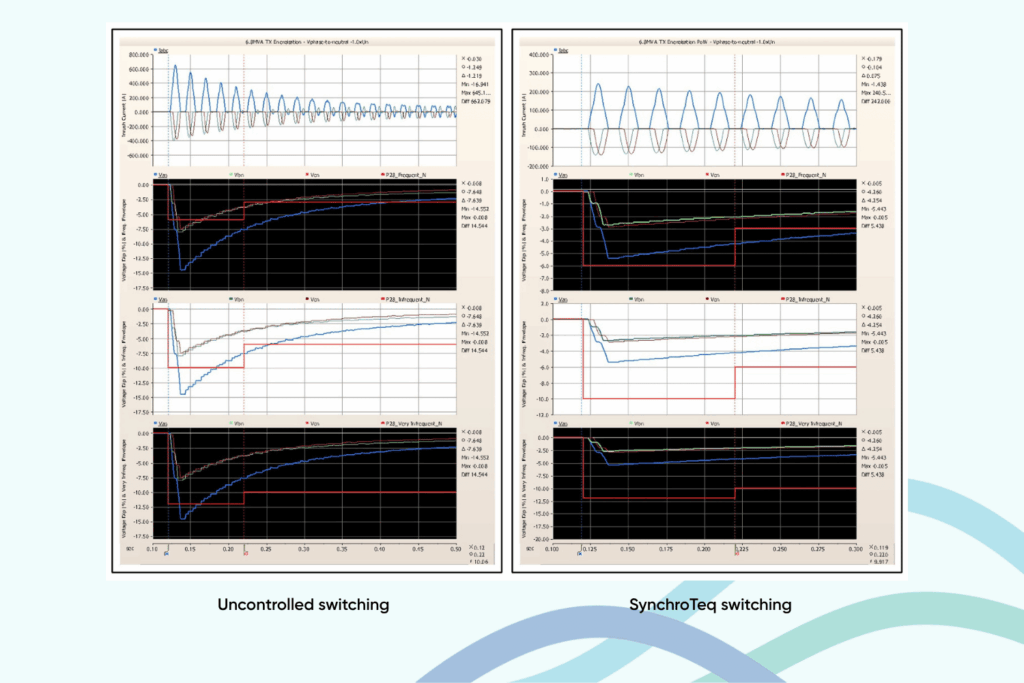
As shown, uncontrolled switching fails to achieve compliance against the P28 very infrequent limits. However, the introduction of the SynchroTeq device has ensured compliance with the infrequent limits.
Contact our experienced engineering and consultancy teams here to learn more.
About the Author
Sushumna Raja is a Power Systems Engineer at Enspec Power. She works on a variety of projects across the power and energy sector, applying engineering expertise to support the design, analysis and performance of electrical power systems.