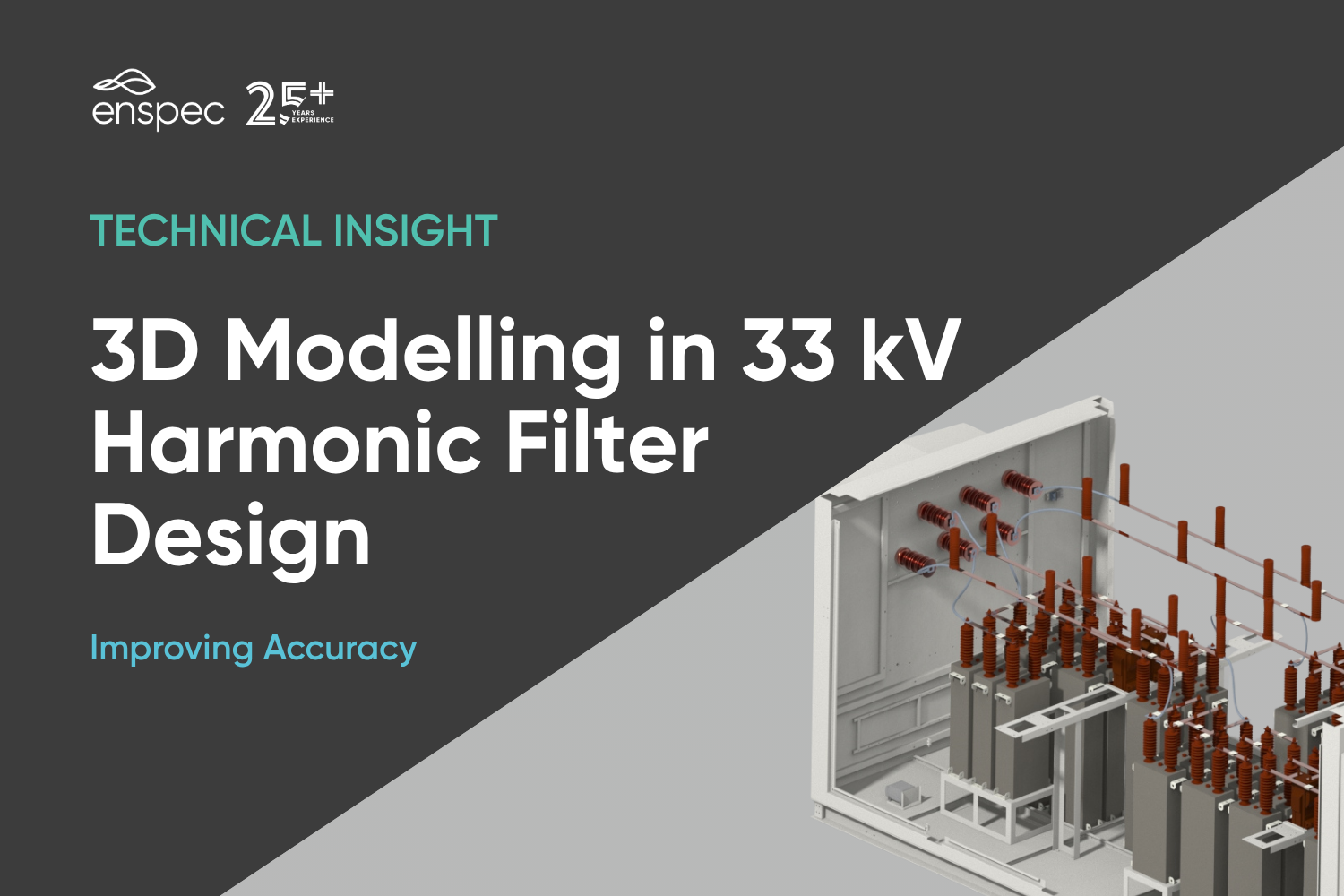

As harmonic filter systems at 33 kV become more complex, the limitations of traditional 2D design approaches are becoming increasingly clear.
In simpler layouts, 2D drawings were sufficient. But as equipment density increases and electrical clearances become tighter, the margin for interpretation disappears.
One of the biggest challenges with 2D design is the lack of spatial clarity. Engineers are required to interpret multiple drawings across plan, elevation, and section views, which introduces risk. Critical issues such as clashes between busbars, structures, and equipment are often only identified during installation.
This creates a downstream impact.
>More RFIs.
>More rework.
>More uncertainty during manufacturing and site execution.
Moving from interpretation to definition
The shift to full 3D modelling is not just a change in tools. It is a shift in how systems are defined.
Instead of relying on interpretation, 3D models allow engineers to validate:
- Electrical clearances between phases and to earth
- Busbar routing, bend radii, and connection interfaces
- Cable tray routing and termination constraints
- Structural integration, including steelwork and foundations
- Maintenance access and lifting requirements
The result is a design that is not just conceptually correct, but fully buildable.
A single source of truth across teams
One of the most important changes is how teams interact with the design.
3D modelling creates a coordinated environment between Engineering, Manufacturing, and Site Services.
- Manufacturing can extract fabrication-ready data directly from the model
- Site teams can clearly understand installation sequences and constraints
- Cross-discipline coordination happens earlier, with clash detection built into the process
This reduces ambiguity and removes the need for assumptions during delivery.
Measurable impact on project delivery
The transition to 3D modelling has led to clear improvements:
- Reduced design errors
- Lower RFI volumes
- Fewer manufacturing delays
These improvements are driven by early validation and accurate interface definition, which reduce the risk of issues appearing late in the project lifecycle.
Building capability for higher voltage systems
As projects scale towards higher voltages, including 132 kV and beyond, geometric accuracy becomes even more critical.
At these levels, clearances, creepage distances, and insulation coordination are design-critical. 3D modelling allows these constraints to be validated rigorously before any equipment is manufactured or installed.
It also opens the door to:
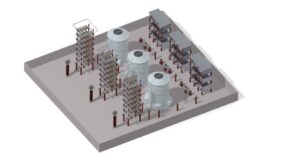
- Digital prototyping of full filter bays
- Integration with simulation tools for harmonic and thermal performance
- More compact and optimised designs
What this means
The move from 2D to 3D modelling represents a shift from drawing-based design to data-driven engineering.
It improves accuracy, reduces project risk, and strengthens the ability to deliver complex harmonic filter systems with confidence.