
Japan’s offshore wind sector is entering a period of significant growth. As projects increase in scale and move into more remote coastal locations, developers are facing a common engineering challenge: connecting large generating assets to parts of the network with relatively low fault levels and limited system strength.
Weak grid connections require careful consideration from the earliest stages of project development. Equipment selection, energisation strategy and network behaviour all have a greater influence on the successful delivery of a project than they would on a stronger transmission system. Decisions made during design can affect commissioning, long-term operation and compliance with local grid requirements.
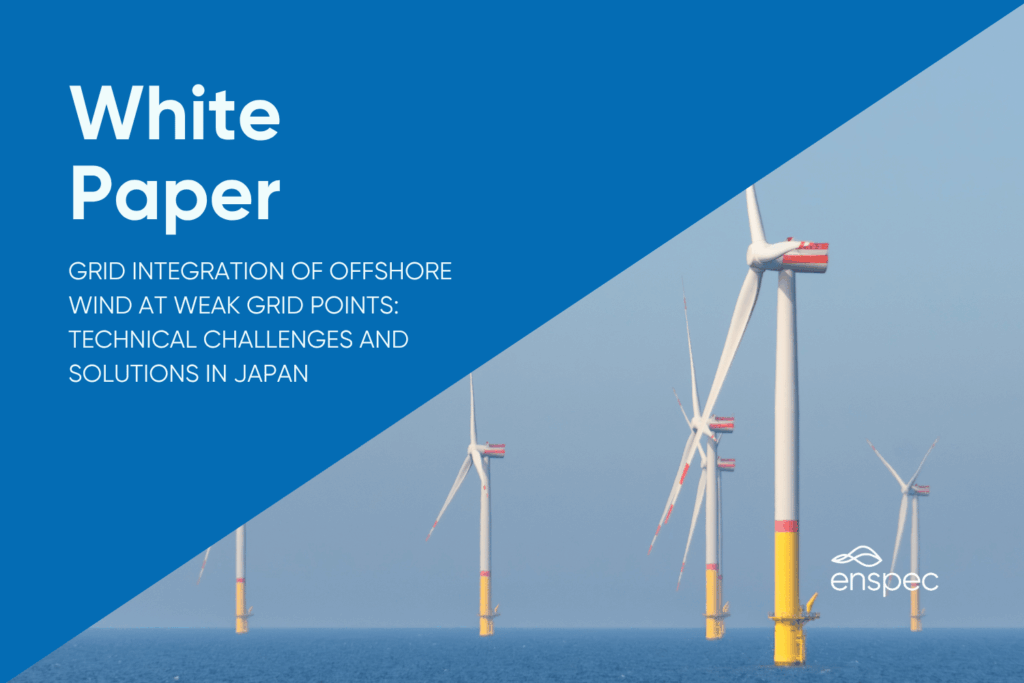
To explore these challenges in more detail, Enspec Power has published a new technical white paper examining offshore wind grid integration in Japan. Drawing on experience gained through major offshore wind projects in the UK, including the Viking Wind Farm, the paper considers how established engineering approaches can help address the demands of weaker grid connection points.
The paper examines several technical areas that are becoming increasingly important as offshore wind developments continue to expand. It explores how different grid compliance requirements influence project design, the impact of transformer energisation on network voltage, and the role of Point-on-Wave switching in reducing inrush current. It also considers the behaviour of long HVAC export cables, including Ferranti effect, harmonic resonance and reactive compensation, before examining the importance of EMT simulation studies during project planning.
Although the discussion focuses on Japan, many of the engineering principles are equally relevant to projects elsewhere. As renewable generation continues to connect to weaker areas of transmission networks around the world, understanding transient behaviour and planning for energisation becomes increasingly valuable. Early technical studies help identify potential issues before commissioning, reducing project risk and supporting a smoother route to grid compliance.
The white paper has been written for engineers, developers and network professionals involved in offshore wind projects or wider grid integration studies. It provides practical technical insight rather than product promotion, combining industry experience with lessons learned from real project applications.
Download the technical paper to explore:
- Weak grid connection challenges for offshore wind developments.
- Grid compliance considerations in Japan and comparisons with UK practice.
- Transformer energisation, inrush current and Point-on-Wave switching.
- Long HVAC export cable behaviour, including Ferranti effect and harmonic resonance.
- The role of EMT studies in supporting successful offshore wind grid integration.
Grid Integration of Offshore Wind at Weak Grid Points Technical Challenges and Solutions in Japan
Send download link to: